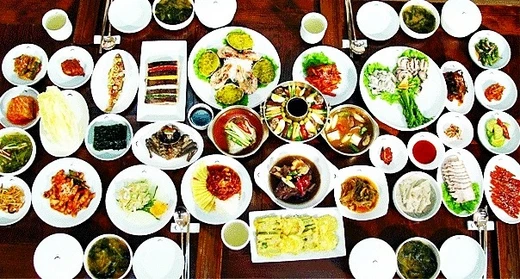
Dotori-muk
A Korean jelly made from acorn starch.
Dotori-muk (도토리묵), also called acorn jelly, is a Korean jelly made from acorn starch. This dish dates back to ancient times, when oak trees in Korea’s mountains produced enough acorns each autumn to serve as a reliable food source. Because it does not spoil easily, dotori-muk has a long shelf life, making it practical for long journeys.
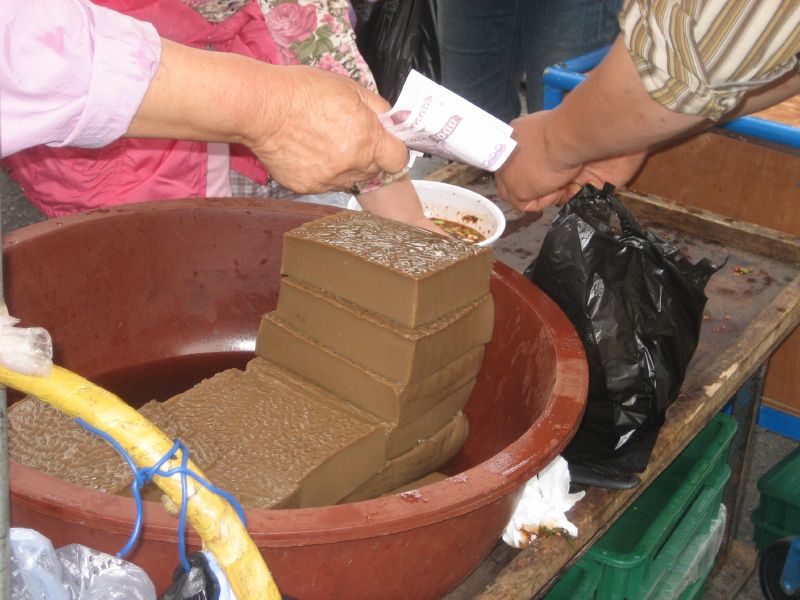
Acorns are rich in starch and protein, but they also contain high levels of tannins and other polyphenols that prevent proper digestion. Before consumption, harvested acorns must be leached of these tannins. Acorns are collected from the ground or knocked from branches, then opened and ground into a fine orange-brown paste. This paste is stirred into water, and the fiber is removed by sieving and settling. The starch-water mixture is left to sit so tannins diffuse into the water, which is changed several times; the soaking time depends on the tannin content. Once tannin-free, the starch-water suspension turns off-white. The starch settles at the bottom, the water is drained, and the paste is dried in trays. The dried starch cake is then pulverized and packaged for sale. Dotori-muk is also available as a powder, which is mixed with water, boiled until pudding-like, and set in a flat dish.
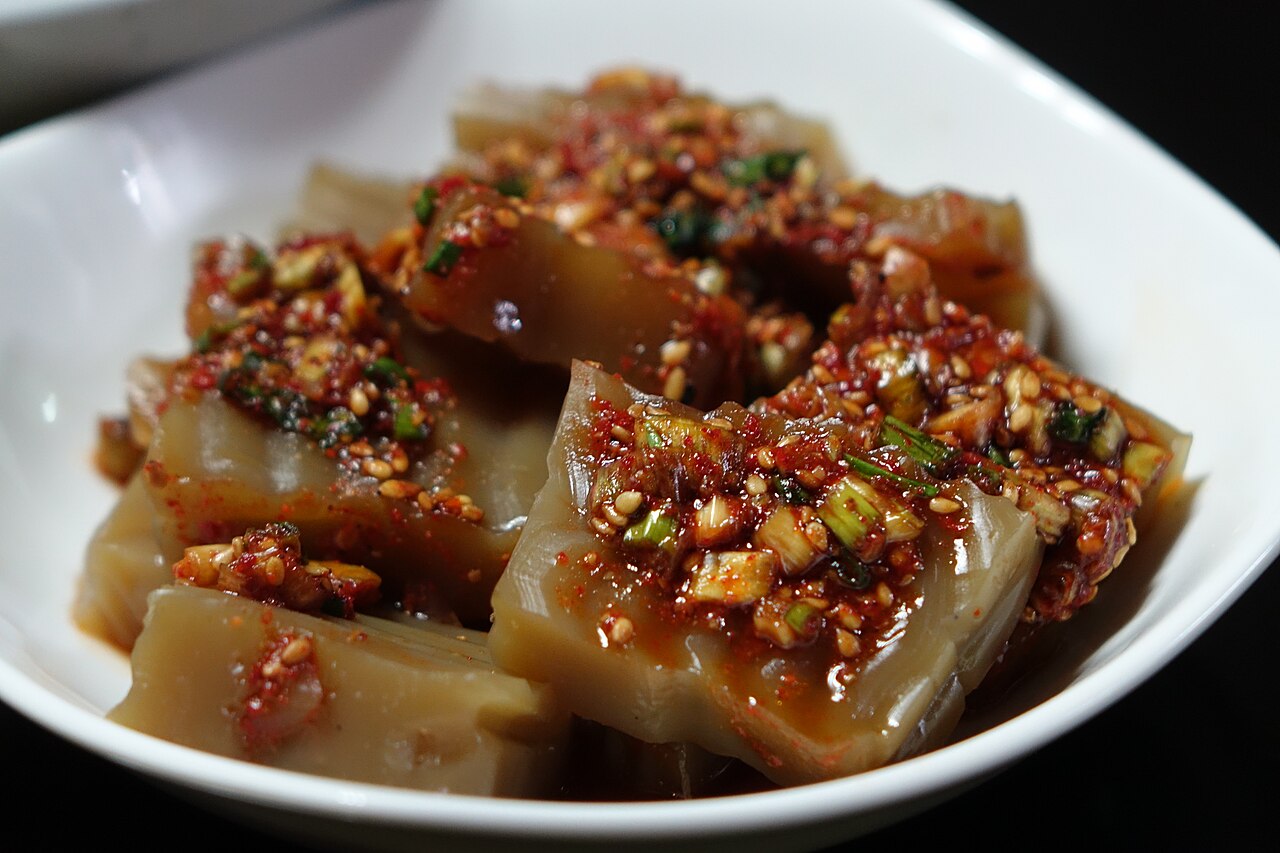
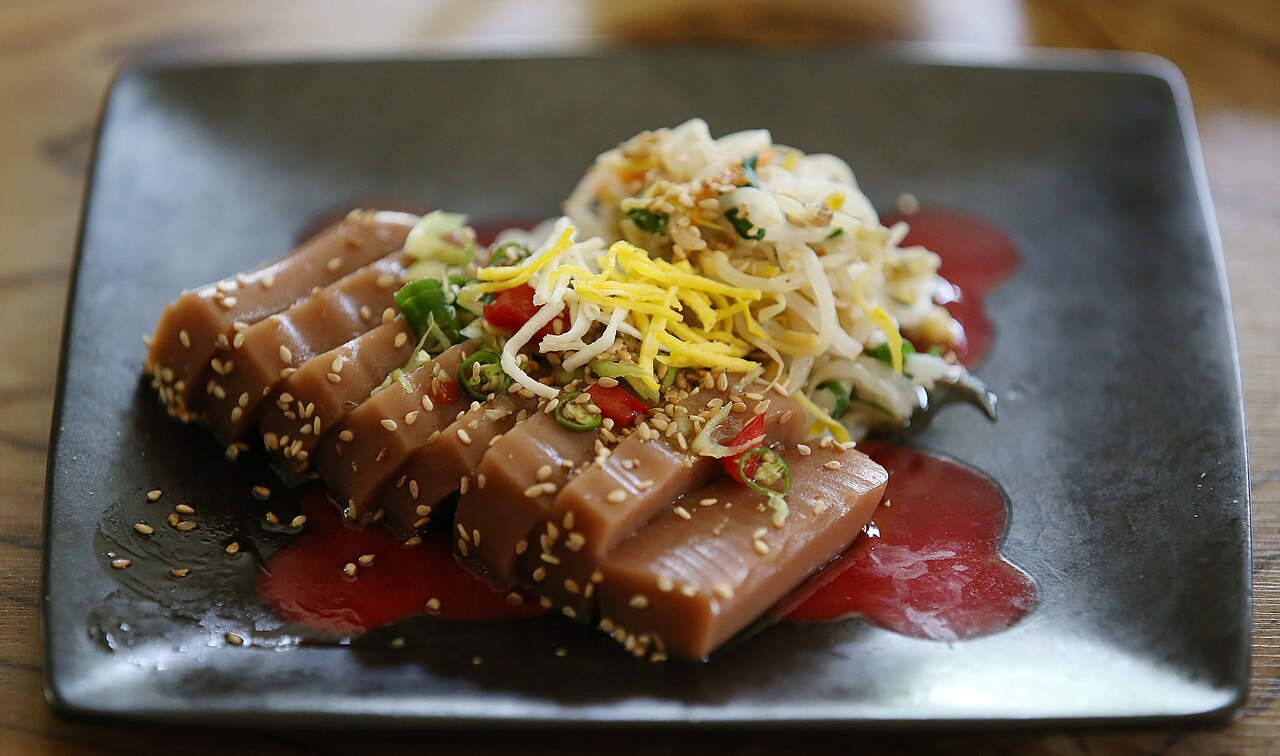
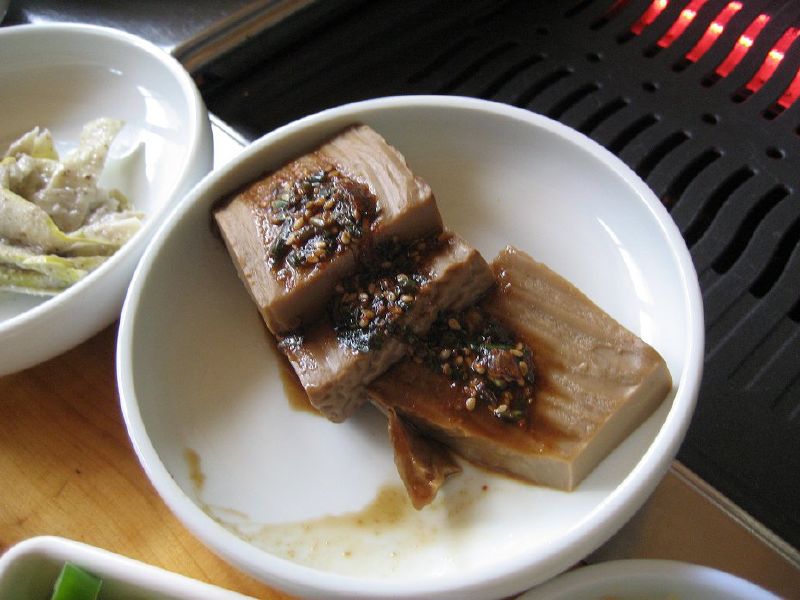
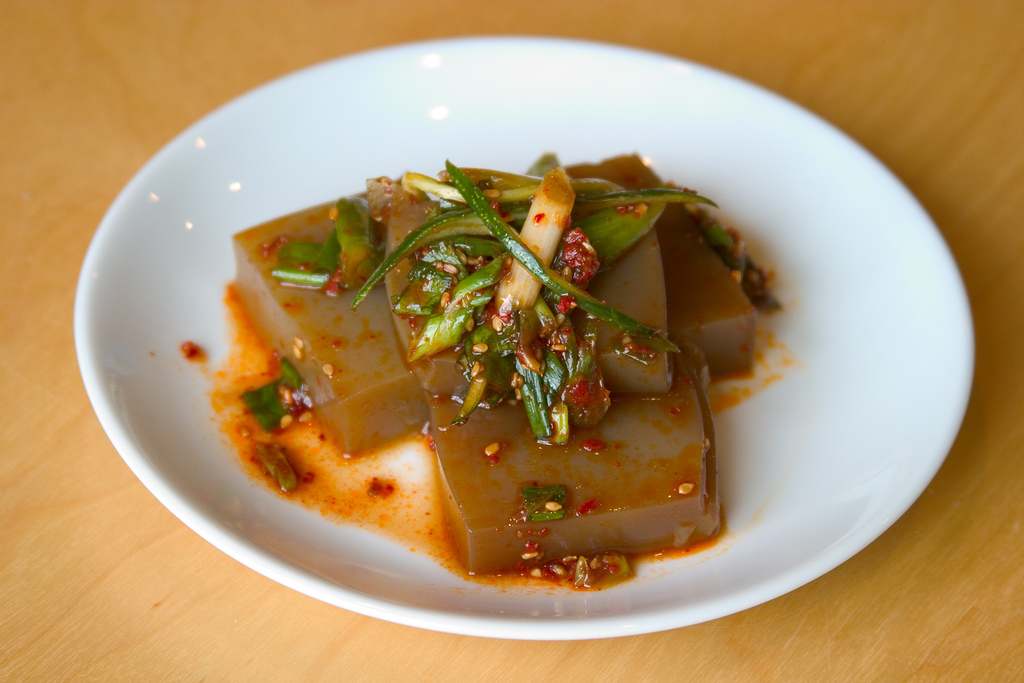
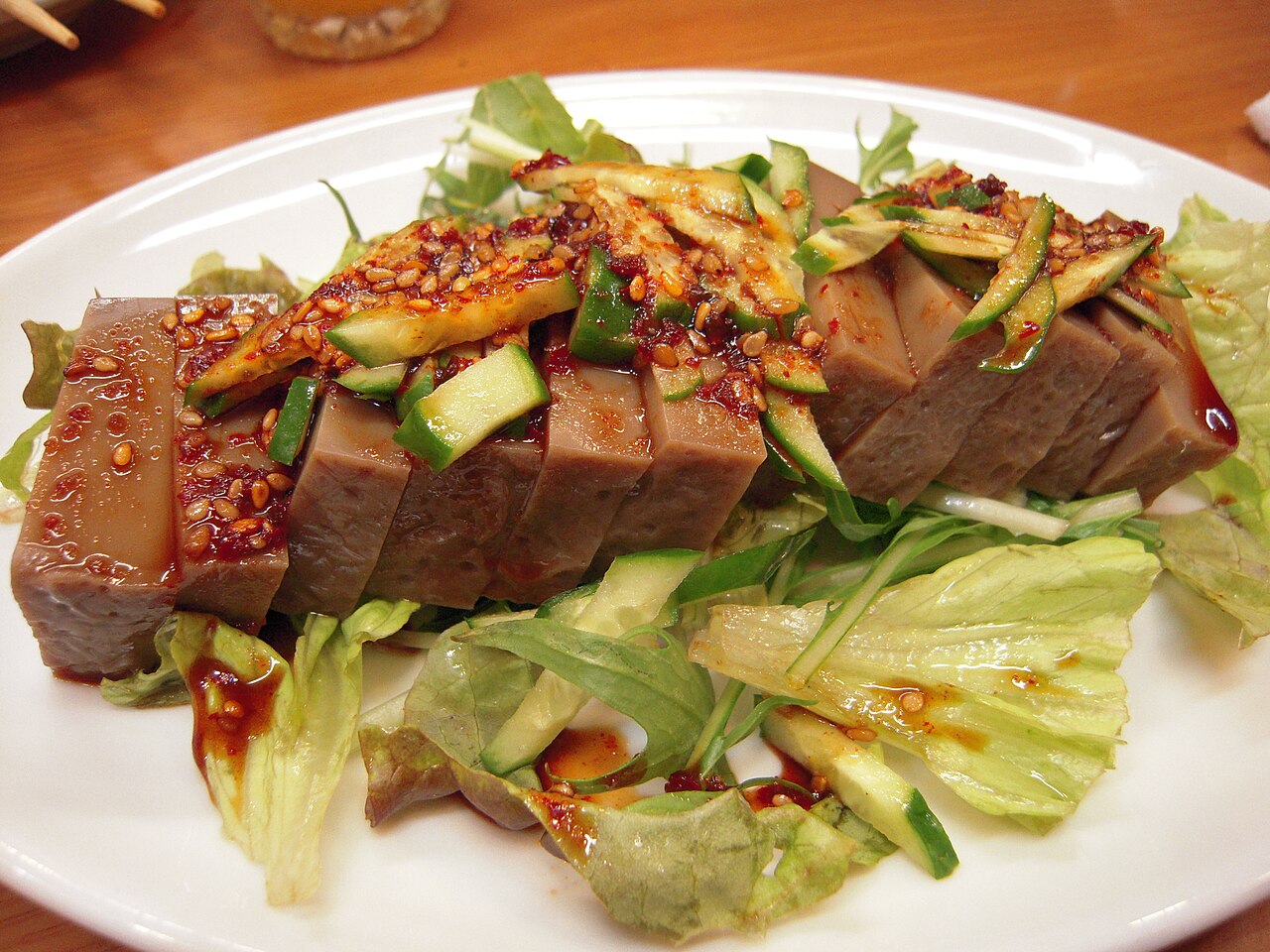
Like other muk, dotori-muk is most often eaten as dotori-muk-muchim (도토리묵무침), a side dish where small chunks are seasoned and mixed with ingredients like slivered carrots, scallions, garlic, soy sauce, sesame oil, red chili powder, and sesame seeds. Muk-mari (묵말이) is also well known. In the Gujeuk neighborhood of Daejeon, a “muk alley” formed around the popular restaurant ‘Grandma’s House’ (할머니집), founded in the late 1960s. At Expo ’93 in Daejeon, Gujeuk dotori-muk was named a representative local food and gained national fame. Muk cooking by a woman began drawing attention. Muk-mari is made with salted seaweed (chopped seaweed powder) for a rich texture, using dried acorn.
During the first Japanese invasion of Joseon, King Seonjo took refuge in the north. Food shortages from the invasion made it hard for villagers to find something to serve the king and his entourage, so they hastily made dotori-muk. Later, even after returning to the palace, King Seonjo often ate dotori-muk as a reminder of the war’s hardships.
- field
- Cuisine
- nationality
- Korean
- known_for
- Acorn jelly dish with long shelf life
- type
- Food dish
- main_ingredient
- Acorn starch
Lore & Background
Dotori-muk is made from acorn starch, which has a high degree of gelatinization. Harvested acorns must be leached of tannins before consumption, as tannins prevent proper digestion. The acorns are ground into a paste, mixed with water, and the starch is separated from fiber through sieving and settling. The starch-water mixture is soaked to remove tannins, then the starch is dried and pulverized for sale.
Dotori-muk is commonly eaten as dotori-muk-muchim, a side dish with chunks of jelly seasoned with carrots, scallions, garlic, soy sauce, sesame oil, red chili powder, and sesame seeds. Muk-mari is another famous dish, made with salted seaweed and dried acorn. In the Gujeuk neighbourhood of Daejeon, a 'muk alley' formed around the restaurant 'Grandma's House' founded in the late 1960s. At Expo '93 in Daejeon, Gujeuk dotori-muk was designated a representative local food.
Reader's Guide
Dotori-muk holds significance as a traditional Korean food with ancient origins, valued for its long shelf life and suitability for travel. Its production involves leaching tannins from acorns, a process essential for safe consumption. The dish gained national recognition when Gujeuk dotori-muk was designated a representative local food at Expo '93 in Daejeon. Historically, during the first Japanese invasion of Joseon, King Seonjo took refuge in the north, and villagers made dotori-muk for him due to food shortages. After returning to the palace, the king often ate dotori-muk as a sign he would not forget the hardships of war. Today, dotori-muk is commercially available in powdered form and is served in various dishes, reflecting its enduring role in Korean cuisine.
Did You Know?
- Dotori-muk does not spoil easily, making it suitable for long travels.
- Acorns must be leached of tannins before consumption because tannins prevent proper digestion.
- During the first Japanese invasion of Joseon, King Seonjo ate dotori-muk made by villagers when he took refuge in the north.
- At Expo '93 in Daejeon, Gujeuk dotori-muk was designated a representative local food.
Ancient Roots and Royal Memory
Dotori-muk traces its origins to a time when oak groves blanketed the Korean mountains and their autumn bounty of acorns offered a dependable food source for communities that depended on them. The jelly's practical virtues—resistance to spoilage and a long shelf life—made it an ideal provision for extended journeys, a quality that would prove decisive in moments of crisis. During the first Japanese invasion of Joseon, King Seonjo fled northward, and the scarcity of food left villagers scrambling to feed the royal entourage. They turned to what they had on hand: acorns, transformed into dotori-muk in a hurry. The dish left such a lasting impression that even after returning to the palace, the king continued to eat it regularly, treating each serving as a deliberate reminder of the war's hardships. This royal association elevated a humble mountain food into a symbol of resilience and collective memory.
The Labor of Tannin Removal
Acorns are deceptively rich in starch and protein, yet they carry a serious biological obstacle: large quantities of tannins and other polyphenols that the human digestive system cannot properly process. Harvesters collect acorns either by sweeping the ground beneath trees or by knocking them loose from branches. Each nut is cracked open, and the kernel is ground into a fine orange-brown paste. That paste is stirred into large vats of water, where repeated sieving and settling separate the fibrous material from the starchy suspension. The critical step follows: the starch-water mixture is left to sit so that tannins slowly diffuse out into the surrounding water, which is then drained and replaced—sometimes several times over, depending on how much tannin the original paste carried. Only when the suspension shifts to an off-white hue can the cook be confident the tannins have been sufficiently leached. The starch is then settled, drained, spread into trays to dry, and finally pulverized into a fine cake ready for packaging.
From Side Dish to Regional Icon
In everyday Korean kitchens, dotori-muk most often appears as dotori-muk-muchim, a seasoned side dish in which small chunks of the jelly are tossed with slivered carrots, scallions, garlic, soy sauce, sesame oil, red chili powder, and sesame seeds. Yet the jelly's most celebrated incarnation emerged in the Gujeuk neighbourhood of Daejeon, where a muk alley gradually formed around a beloved restaurant called Grandma's House, established in the late 1960s. The restaurant's signature preparation, muk-mari, combines salted seaweed—chopped into a rich-textured powder—with dried acorn, creating a distinctive layered dish that drew growing crowds. A woman's hands behind the muk cooking became a point of local pride and curiosity. The turning point for national recognition came at Expo '93 in Daejeon, when Gujeuk dotori-muk was officially designated a representative local food. That single designation transformed a neighbourhood specialty into a dish known across the country.
Place in the Broader Muk Tradition
Dotori-muk belongs to a wider family of Korean jellies collectively called muk, each defined by its starch source. Nokdumuk is made from mung beans, hwangpomuk takes a distinctive yellow hue also from mung beans, and memilmuk draws its character from buckwheat. Across the border, Japan has its own konjac jelly tradition. What unites these preparations is the principle of extracting starch from a plant, gelatinizing it into a firm yet yielding set, and then seasoning or serving it in ways that highlight its clean, slightly chewy texture. Dotori-muk's particular identity comes from the acorn's high degree of gelatinization, which gives the jelly a firmness that distinguishes it from bean-based or buckwheat counterparts. The commercial availability of dotori-muk in powdered form—mixed with water, boiled to a pudding-like consistency, then set in a flat dish—has made the ancient mountain preparation accessible to home cooks who never harvest a single acorn. In this way, a food born from autumn oak groves now sits on grocery shelves alongside its mung-bean and buckwheat siblings.
Gallery
Frequently Asked Questions
What is Dotori-muk?
Dotori-muk is a traditional Korean jelly dish made from acorn starch. It is also commonly referred to as acorn jelly.
What is the main ingredient in Dotori-muk?
The core ingredient is starch extracted from acorns. Because raw acorns carry high levels of tannins and polyphenols that hinder digestion, they must be leached of those compounds before the starch can be used.
How old is Dotori-muk as a dish?
It traces back to ancient Korea, when oak trees in the mountains yielded a dependable autumn harvest of acorns. Communities relied on that seasonal abundance as a staple food source long before modern refrigeration existed.
Why was Dotori-muk popular for long journeys?
Unlike many fresh foods, the jelly resists spoilage and keeps well over extended periods. That long shelf life made it a practical provision for travelers heading into the mountains or on lengthy trips.
What makes Dotori-muk different from other Korean jellies?
Its defining feature is the acorn-starch base, which gives it a distinct earthy flavor and firm, slightly grainy texture. The multi-step tannin-leaching process also sets its preparation apart from simpler starch-based jellies.
More in Korean cuisine 1-24
Spotted an error? Know more?
This is a living reference — every entry is fact-audited, and reader corrections feed straight into our audit queue. Suggest an edit · See this site's audit record